

Real Traffic Car Simulator 3D
Safari MMS
Real Traffic Car Simulator 3D is a free racing game from Safari MMS that focuses on the simple appeal of driving quickly through highway traffic. I found its strongest quality in how easy the idea is to understand: you start the game, get behind the wheel, and the road becomes a test of timing, attention, and restraint. It is not trying to replace a full console-style racing experience. Instead, it suits short sessions when I want something direct and uncomplicated.
The game has attracted more than 500 thousand installs, and its average rating is 5.0 from roughly 393 ratings. Those figures suggest that the basic concept connects with many players, although the small number of written reviews means the rating alone does not tell the whole story. I would treat it as an encouraging sign rather than a complete picture of long-term depth.
What the highway experience feels like
The central challenge is not simply pressing the accelerator. Highway racing becomes interesting when traffic limits the space available to move, forcing me to judge gaps before committing to a pass. A quick lane change can feel rewarding when it works, but the same decision becomes a mistake if I react too late or focus only on speed.
That makes the game a good fit for players who enjoy reflex-based driving without wanting to learn a complicated control system first. I can pick it up for a few minutes and immediately understand the objective. The short-session nature also works well when I am waiting for an appointment or taking a brief break, because the game does not require the kind of long preparation associated with larger racing titles.
At the same time, the straightforward design may not satisfy someone looking for a broad career mode, deep vehicle tuning, licensed cars, or a large competitive community. Those expectations belong more naturally to established racing games with extensive progression systems. Here, the pleasure comes from handling traffic and maintaining concentration, not from building a collection or managing a detailed racing team.
Related News






Where new players usually get stuck
The first difficulty is often visual rather than technical. Highway traffic can make the road feel busy, and a player who watches the nearest vehicle too closely may miss what is developing farther ahead. I get better results by scanning beyond the car directly in front of me, checking the next opening before I need it. That small habit reduces panic and makes movement feel deliberate.
Another common mistake is treating every available gap as an invitation to overtake. In a traffic-focused racer, an opening can close before the car reaches it. I prefer to choose a lane early, hold a predictable line, and change position only when the next space is clear. This approach may look slower at first, but it produces more consistent runs than constant last-second corrections.
Players can also become frustrated by restarting too quickly after a poor move. I found it more useful to identify the exact moment the run went wrong. Was I already too close to the vehicle ahead? Did I change lanes without checking the following space? Did I accelerate while still deciding where to go? Naming the mistake turns a failed attempt into practice instead of making every collision feel random.
Gallery
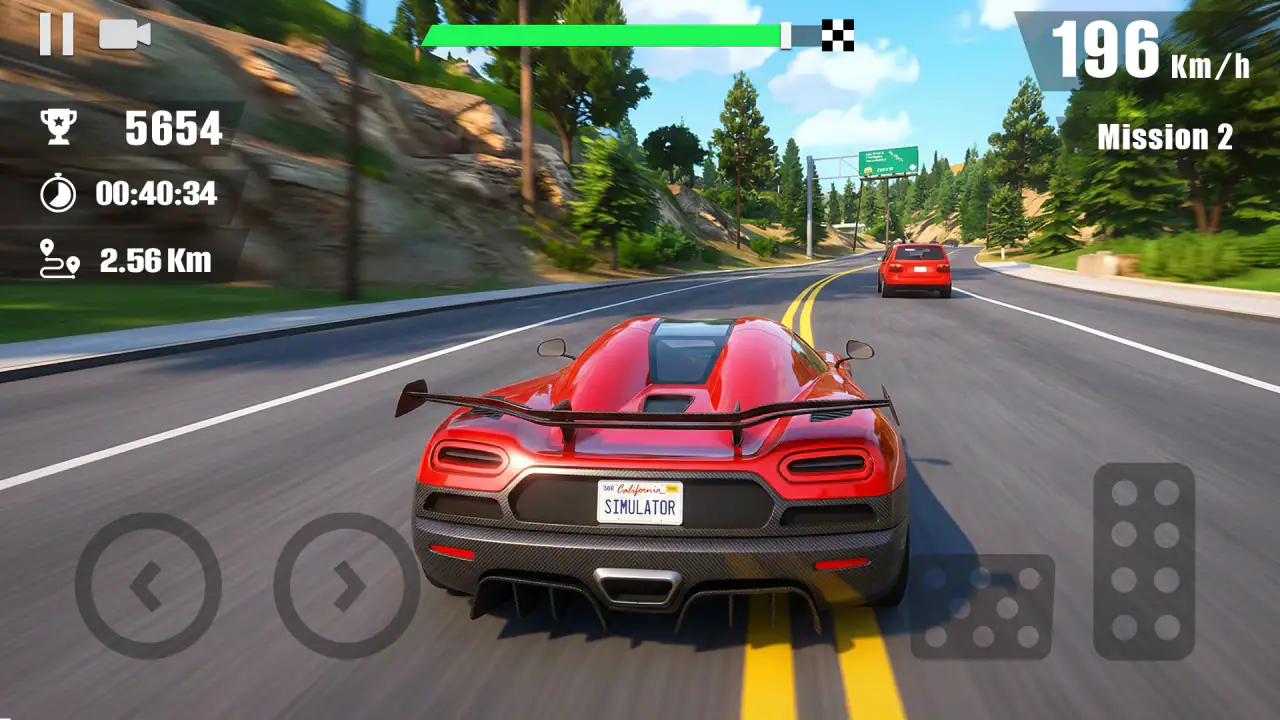
The most useful early technique is to plan one move ahead rather than react to the bumper immediately in front of you. It sounds basic, but it changes the rhythm of the game. The road becomes less about frantic swerving and more about reading patterns in traffic.
Setup checks before blaming the game
Because this is a mobile racing game, the first setup check is simple: make sure the device has enough free space and that other demanding apps are closed before starting a session. I would also restart the phone if the game feels unusually sluggish after a long period of use. That is general maintenance, but it can prevent a temporary device problem from being mistaken for a fault in the game.
Real Traffic Car Simulator 3D supports Android 7.0 and later, which makes it accessible to older compatible phones as well as newer models. Compatibility does not guarantee identical performance on every device, however. If the game feels less responsive on an older phone, I would first check whether the device is warm, whether many background apps are active, and whether the system itself is waiting for updates.
The game is free, so the initial decision is low risk. I can install it without committing to a purchase, try the controls, and decide quickly whether the driving style suits me. That is particularly useful for parents or casual players who want an age rating of Everyone and a game that can be tested without paying at the outset.
On an iPhone or iPad, I would use the same practical approach: close unused apps, keep the operating system current, and test the game after the device has cooled if performance appears inconsistent. I would not assume that a poor session automatically means the game is broken. Touch response, battery-saving behavior, heat, and crowded background activity can all affect a racing game where timing matters.
The current version is 1.1.0. If a player has trouble launching or notices behavior that seems unusual, checking that the installed version is current is a sensible first step. After that, a full close and restart is worth trying before more complicated troubleshooting. These checks do not change the game itself, but they remove several avoidable sources of friction.
Recovering a frustrating session
When a run starts badly, my preferred recovery method is to simplify the next few seconds. Instead of attempting an ambitious pass, I hold a stable line and wait for a clearer opening. This is especially helpful after a near miss, because hurried corrections often create a second mistake. The aim is to regain a predictable rhythm before attempting another lane change.
If the controls seem unresponsive, I would first distinguish between delayed input and a decision made too late. In a fast traffic game, the screen can appear to ignore a command when the real problem is that the move began after the safe window had already closed. Testing a few gentle inputs on a clear stretch helps reveal whether the issue is the control itself or the timing of the player.
A useful personal workflow is to play in short focused attempts rather than treating every session as a race for the highest possible speed. During the first attempt, I watch how traffic develops. During the next, I work on maintaining a lane. Only after that do I push for more aggressive overtakes. This separates learning from risk-taking and makes improvement easier to notice.
If the game closes unexpectedly, I would relaunch it after stopping other apps and restarting the device. If the problem continues, reinstalling is a reasonable general step, but I would do that only after considering whether any local progress could be affected. I would not repeatedly delete and reinstall the game as a first response, since that adds inconvenience without identifying the real cause.
For a family device, another practical check is whether storage is nearly full or whether the phone is operating under a restrictive battery mode. Either condition can interfere with smooth play. A quick test on a normally charged, cooler device can tell me whether the problem follows the game or the phone’s current state.
When the app may not be the cause
Not every collision is evidence of poor game behavior. Highway racing places unusual demands on visual attention, and glare, a dirty screen, or playing while walking can make accurate control much harder. I get a fairer impression when I play while seated, with the screen clean and the device held steadily in both hands.
Network assumptions can also lead to confusion. I would not judge a short driving session by the standards of an online multiplayer game. If a player expects live opponents, shared races, or a persistent social competition, this may simply be the wrong category of experience rather than a technical failure. Its appeal is the immediate traffic challenge, so people seeking a connected racing ecosystem should compare it with games designed around that purpose.
Device age matters too. Android compatibility begins at version 7.0, but an operating system requirement is only a baseline. An older phone may technically run the game while still delivering less comfortable performance than a newer model. If the game is playable but not smooth, reducing background activity and avoiding heat are sensible tests before deciding whether the title deserves blame.
There is also a difference between a game feeling repetitive and a game malfunctioning. The focused highway format can become familiar if I want a large variety of tracks, objectives, or progression choices. That is a design limitation for some players, not something a reinstall will solve. In that situation, a more feature-heavy racing alternative would be a better choice.
Who will enjoy it most
I would recommend it to someone who likes quick driving challenges, wants a free game, and prefers learning through immediate play rather than reading a long tutorial. It is also suitable for casual players who enjoy improving a personal rhythm: choosing safer gaps, avoiding unnecessary swerves, and gradually becoming more confident around traffic.
It can work well as a shared family download because the content rating is Everyone and the premise is easy to explain. A younger player may enjoy the speed and movement, while an older player can focus on precision and risk management. I would still encourage adults to check the game personally first, since age suitability does not guarantee that every control style will appeal to every child.
I would skip it if my priority were realistic motorsport strategy, extensive customization, story-driven progression, or a large selection of carefully differentiated events. I would also look elsewhere if I became bored with repeating the same kind of highway decision. The game’s narrow focus is exactly what makes it approachable, but it is also the reason it may not hold the attention of players seeking variety.
How it compares with familiar racing alternatives
Compared with circuit racers, this game places less emphasis on ideal racing lines and more on reacting to ordinary traffic. A track racer rewards learning corners and braking points; this experience rewards awareness of moving obstacles and patience between overtakes. Neither approach is automatically better. I prefer this one when I want a quick test of concentration rather than a structured lap-based competition.
Compared with arcade racers built around boosts, stunts, and dramatic events, the highway format feels more restrained. The tension comes from the limited space around other vehicles, so success depends on choosing when not to move. That can feel more satisfying to players who like controlled risk, but less exciting to anyone who expects constant spectacle.
Compared with realistic driving simulators, it is easier to approach but less likely to satisfy someone who wants detailed vehicle behavior. I would choose the simulator for careful practice and this game for a fast, accessible break. The right choice depends on whether I want to study driving systems or simply stay alert and make clean decisions.
My practical verdict
After spending time with Real Traffic Car Simulator 3D, I see it as a focused free racing game rather than a complete driving package. Safari MMS keeps the premise direct: highway traffic creates the pressure, and the player’s judgment determines how long the run remains under control. That clarity is its main strength.
The rating of 5.0 and its broad install reach make it worth trying, but I would still approach it with realistic expectations. The limited written feedback means I would judge it through my own first session, especially the feel of the controls and whether the traffic challenge remains enjoyable after the novelty fades.
My advice is to install it, begin with conservative lane choices, and give the device a clean, cool, distraction-free test. If you enjoy reading traffic and improving through short attempts, it can become a pleasant everyday time-filler. If you need deep progression or a wide racing catalogue, choose a larger alternative instead. For quick, uncomplicated highway racing, this is an easy game to try and an even easier one to understand.
FAQs for Real Traffic Car Simulator 3D
What is Real Traffic Car Simulator 3D?
Real Traffic Car Simulator 3D is a driving game focused on navigating busy roads while managing speed, steering, and traffic around you. It combines realistic-looking vehicles, road environments, and traffic situations with simple simulator-style gameplay. Depending on the mode available on your device, you may be able to complete driving challenges, travel through different locations, and improve your performance by avoiding crashes.
How do you play Real Traffic Car Simulator 3D?
The main objective is to control your car through traffic and drive as safely or efficiently as possible. On-screen controls normally let you steer, accelerate, and brake, while some versions may offer camera or control options. Successful driving requires attention to surrounding vehicles, lane changes, turns, and obstacles. Completing objectives and driving longer distances can help you progress.
Does Real Traffic Car Simulator 3D work offline?
The game may be playable without a constant internet connection, especially for its basic driving and single-player features. However, certain elements can still require internet access, including advertisements, analytics, updates, cloud-related services, or optional online content. Before relying on offline play, it is worth opening the game once while connected and checking whether every mode and feature remains available without a connection.
Is Real Traffic Car Simulator 3D free to download?
Real Traffic Car Simulator 3D is generally offered as a free download, allowing users to install and try the core gameplay without an upfront purchase. Free mobile games commonly include advertising and may provide optional in-app purchases, such as removing ads, unlocking vehicles, or obtaining virtual currency. Check the official store listing for the current pricing, permissions, and purchase information before downloading.
What devices are compatible with Real Traffic Car Simulator 3D?
Compatibility depends on the version of the game and the operating system used by your phone or tablet. A reasonably modern Android or iOS device should provide the best experience, particularly because 3D graphics and active traffic scenes can require noticeable processing power. Older devices may experience slower loading, reduced visual quality, or occasional performance issues, so review the store requirements before installation.
Pros
- Realistic traffic makes every drive feel more challenging.
- Large selection of cars with varied handling characteristics.
- Simple controls are easy to learn for new players.
- Multiple camera views improve visibility while driving.
- Works well for short gaming sessions on mobile devices.
Cons
- Ads may interrupt gameplay
- especially between driving sessions.
- Some vehicles and upgrades require significant in-game currency.
- Traffic behavior can occasionally feel predictable or repetitive.
- Graphics may look dated on newer phones and tablets.
- Limited customization reduces long-term variety for some players.


